


Connected Objects
DwarfLabs Dwarf Mini Telescope: review/test
Published on: 29-11-2025 / Modified: 07-01-2026
It has been two or three years since Dwarflab, Seestar and Vaonis embarked on their adventure into electronic telescopes for the general public, and it has changed everything. Telescopes used to be complicated instruments to set up and use, and you also needed a huge amount of patience to take photographs. I've been there: I still have my ‘old’ 750 mm telescope, but it mainly serves as a decorative object, as I don't have the time to use it.
For better or worse, we live in a society where patience is not the norm and everything has to happen quickly. These three brands have understood this well: they have designed products that are easy to use and capable of producing results quickly, without any hassle. They are all controlled by an app, and it only takes a few clicks to launch them and start photographing the sky.
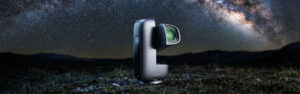
This Dwarf Mini is the fifth electronic telescope I have tested. I have also tested the Dwarf 2 and Dwarf 3 from the same brand. This new Dwarf Mini differs from its predecessors with a separate adjustable tube and a tiny format. Now I just have to cross my fingers for clear skies as soon as possible so I can test it!
Where to buy?
The Dwarf Mini is available for pre-order on the official website for $399: Dwarf Mini / Dwarflabs.comUnboxing

The box includes the telescope, a charging cable (USB Type-C), a manual, a solar filter, and a soft cloth for cleaning the optics.
I say it often: packaging is useless. Still, it often says a lot about the maturity of a product—and the brand behind it. Dwarflabs isn’t new to this, and it shows. The Dwarf Mini clearly feels like a mass-market product, and I wouldn’t be surprised to see it on the shelves of brick-and-mortar stores.
Timeline
28/11/2025: I received the telescope. I can start the review, but progress will depend heavily on the weather and the sky. So I don’t know how long it will take me to finish this test.Overview
Here’s a quick look at the three Dwarf telescopes I’ve tested:
This new model has nothing in common with the previous ones, and without the Dwarflabs logo you might think it was made by another brand. I don’t know whether this hints at future models or if it’s just an experiment. The format feels more suitable, but I’ll see how it plays out in real use.
To charge the telescope, you just plug it into any USB charger. The cable is included in the box, but not the charger. USB lets you charge the telescope, but also access its internal storage to retrieve the files it has created. It’s not mandatory, because you can download files via the app, but if you want the raw files you can get them through the USB port.
To turn the telescope on, just press the large button. When the button is ringed in green, it’s ready to connect to your phone. The other indicators below show how much battery you have left. Since it can be powered over USB, you can also plug it into a power bank if you want more runtime.
The base rotates fully and is almost silent, so you won’t wake your neighbors if you decide to spend the night outside stargazing.
Setup
Setting up a telescope like this doesn’t require any technical expertise—you just follow the instructions in the app.Here are the steps, in short:
Download the Dwarflabs app from the Play Store or the Apple Store
Open the app, and from the home screen choose “Connect”
Accept any permissions requested by the app. Location is very important here, because it lets the telescope determine where it is relative to the sky. You’ll need permissions for Wi-Fi, Bluetooth, GPS, and location.
The app will look for your telescope. Just make sure the light around the power button is green. In most cases, the app will find it immediately.
The app will connect to the telescope. It’s important to understand the basic principle here because it affects how you use your phone. The link between your phone and the telescope is via Wi-Fi, which means you will no longer be connected to your home Wi-Fi. Your phone will then use 4G/5G for internet access and possible updates. This is normal behavior, and it’s the same on all telescopes of this type.
You will probably need to update the telescope and activate it
After the update, the telescope will restart. Once it’s back on, you can start using it.
App
The app is the heart of the product, because without it you can’t do anything. The Dwarflabs app has improved a lot since the last version. It offers automatic observing modes for beginners, but also lets you adjust settings to better use the telescope’s capabilities.From the home screen, you have two ways to use the Dwarf Mini:
Tap the telescope to enter a control interface where you can manually steer the telescope and take photos and videos. If you’ve never used this type of product, I recommend starting with option 2.
Tap the Atlas icon at the bottom of the screen. The app will likely ask you to update the catalog before you can begin. Once that’s done, you’ll have a catalog of celestial objects you can observe—either by selecting them from a list or by browsing the sky on your phone. In both cases, once you’ve made your choice, you use the “Go To” function and the telescope will automatically point to the selected object and begin observing.
If you choose option 2, you may end up pointing at the sky “blind,” meaning the object isn’t actually visible from your location. You’ll notice quickly if the screen stays black—in that case, just pick another target.
Specs
Here’s a quick overview of this telescope’s specs and its main competitors:| Feature | DWARF 2 | DWARF 3 | DWARF mini | Seestar S30 | Seestar S30 Pro | Seestar S50 |
|---|---|---|---|---|---|---|
| Status / positioning | DiscontinuedSuccessor: DWARF 3 | VersatileAstro + panorama + birding | AstroUltra-compact, astro-focused | AstroSeestar entry-level | AstroBetter sensors + higher resolution | Astro“Classic” Seestar 50 mm |
| Aperture / focal length (“tele” / main optics) | 24 mm / 100 mm(≈ f/4.2) | 35 mm / 150 mm(≈ f/4.3) | 30 mm / 150 mm(f/5) | 30 mm / 150 mm(f/5) | 30 mm / 160 mm(f/5.3) | 50 mm / 250 mm(f/5) |
| Wide-angle (if present) | Aperture 2.8 mm / focal length 6.8 mm | Aperture 3.4 mm / focal length 6.7 mm | Aperture 3.4 mm / focal length 6.7 mm | Yes (resolution listed)“specific” sensor (not detailed) | Aperture 3.4 mm / focal length 6 mm(f/1.75) | — |
| Sensor (main) | Sony IMX415 | Sony IMX678 (STARVIS 2) | Sony IMX662 (1/2.8") | Sony IMX662 (1/2.8") | Tele: Sony IMX585Wide: Sony IMX586 | Sony IMX462 |
| Photo resolution (max) | Tele: 3840×2160Wide: N/A (per DWARF table) | Tele: 3840×2160Wide: 1920×1080 | 1920×1080 (≈2 MP) | Tele: 1080×1920Wide: 1920×1080 | Tele: 2160×3840 (8.3 MP)Wide: 2160×3840 (8.3 MP) | 1920×1080 |
| Max exposure time (astro mode) | 15 s | 60 s (tele) / 90 s (wide) (in EQ) | Up to 90 s (in EQ) | N/A (often via auto stacking) | N/A | N/A |
| Built-in filters (examples) | Tele: IR Cut (VIS) / IR PassWide: IR Cut | Tele: VIS / Astro / Dual-bandWide: Astro | Astro / Dark / Duo-band (Ha/OIII) (per product sheet) | N/A | UV/IR cut + “light pollution” filter(and items listed on the product page) | N/A (light-pollution filter via app per docs) |
| Mount / equatorial mode | Alt-azEQ: N/A | Alt-az + EQ mode | Alt-az + EQ mode | Alt-az | Alt-az (supports “Equatorial Mode”) | Alt-az |
| Battery | 5600 mAh (removable) | 10000 mAh (built-in) | 7000 mAh (built-in) | 6000 mAh | 6000 mAh (≈ 6 h listed) | 6000 mAh |
| Internal storage | microSD 64 GB included(max 512 GB) | 128 GB eMMC | 64 GB (internal) | 64 GB eMMC | 128 GB eMMC | 64 GB |
| Weight | 1.2 kg | 1.3 kg | 0.84 kg | 1.65 kg | N/A | 2.5 kg |
| Dimensions | 204 × 130 × 62 mm | 222 × 142 × 65 mm | N/A | N/A | N/A | 142.5 × 130 × 257 mm |
| Connectivity (general) | Wi-Fi / Bluetooth (often listed) | N/A | N/A | Bluetooth + Wi-Fi 5G/2.4G + USB-C | Wi-Fi + USB-C + Bluetooth | Wi-Fi 5G/2.4G + USB-C + Bluetooth |
| Highlights |
|
|
|
|
|
|
Solar observing
The first step is to select the Sun in the Atlas. The telescope will ask you to point at it manually. That’s not too difficult given how bright it is. Once the Sun is in the frame, you can enable tracking and the telescope will compensate for Earth’s rotation without any trouble. Tracking here is just as good as on the other two models.
You can take photos or record video. Solar videos aren’t very interesting because nothing really happens. You won’t see solar flares or anything like that. Photos are more interesting, because you can see sunspots, like in the examples below. The Sun isn’t the most exciting subject for this telescope, but it works and it helps you get familiar with the device. In daylight you have plenty of time to try every feature; at night it’s always a bit more complicated.
Moon observing
I took advantage of a brief clearing on a full-moon night to grab a few photos before the sky clouded over again. I had to point manually because the telescope couldn’t calibrate due to the clouds. For the Moon, that’s not much of a problem because it’s very easy to see. Focus and tracking work quite well: it only takes a few seconds to frame the Moon and keep tracking it. Detail is lower than on the Dwarf 3. You don’t notice it when the full Moon is shown, but when you zoom in, blur quickly appears around the edges.I also used video mode, but thin cloud cover interfered with focus:
I also tested timelapse in the same conditions:
In a wide shot, with the Moon’s brightness, exposure looks fine and video quality is good. But if I reduce exposure to focus more on the Moon, you can see that raising ISO produces a very grainy image.
Planet observing
Not tested yet, but I should point out that this telescope isn’t designed for planets—its focal length is too short. Planets will look only slightly larger than a star, and you won’t see much detail.Deep-sky observing
Context: I’m in a Bortle 5 to 6 area, so it’s not ideal for deep-sky observing. Most of my sessions are between 20 and 30 minutes of exposure.Update 16/12/25
I finally see stars for the first time since I got the telescope, but there’s a thin cloud veil. Conditions aren’t ideal, and yet you’ll see the result is surprisingly good for such a small telescope.
First target: M42
This is by far the easiest target for me, and it’s a beautiful object. While pointing, I notice a first difference compared to the other Dwarf telescopes. Calibration seems to run for every new target, whereas the Dwarf 3 only did it once per session. The Dwarf Mini also reacts more slowly than the Dwarf 3.
So the first step is to point automatically using the Atlas feature in the app:
After calibration, the telescope points automatically and switches to M42 tracking mode. Tracking is flawless, by the way. I can start the capture.
My turn to play with my editing tools (Adobe suite):
If I wore dentures, they would probably have fallen out when I saw this image. The result is simply stunning!
Second target: Barnard 33 (the Horsehead)
I repeat the same process: I point to Barnard 33 automatically and start the capture. The sky was starting to cloud over, and here I couldn’t see the Horsehead in the first frame, but that’s not a big deal. I let the telescope do its work and came back after 87 frames.
As with M42, Barnard 33 is clearly visible. The image is very noisy, but nothing that can’t be recovered. I send the stack to Dwarflabs, and here’s what I got:
The result is less spectacular than for M42, but conditions were worse. Still, I think it’s quite decent and I see potential for more detail. Here’s what it looks like after processing:
I probably pushed the red a bit too far, but the result is still really interesting.
I had to stop the session at this point because of cloud cover, but I’m honestly very impressed by this small telescope. I expected lower optical quality than the Dwarf 3, and that’s true—but the difference isn’t dramatic. On the other hand, Dwarflabs’ processing pushes this telescope up a notch. And if you take the time to work on the image yourself afterwards, you can do even better.
Update 26/12/25
The sky finally cleared. It’s -3°C, and conditions are perfect for observing.
1st target: M31:
M31 is visible in the first frame, but you can’t quite make out its outline yet.
2nd target: IC 1805:
At first you don’t see much. This one requires a bit more patience.
3rd target: M45:
I forgot to take screenshots during the observing session, so I’m showing the final result. M45 is very clearly recognizable here, but without the blue colors you can often see with this object.
4th target: M81
After Dwarflab processing, M81 is perfectly visible after about 30 minutes of exposure. Noise reduction is really effective.
Update 28/12/25
NGC2174 after 248 frames.
Battery life
I tested the telescope in below-freezing temperatures, so battery life wasn’t as good. In these conditions I got roughly 1h30 to 1h45 of runtime, which allowed me to do about three observing sessions on one charge.Connectivity
You connect to the telescope via Wi-Fi. That means that when you’re connected to the telescope’s Wi-Fi, you’re no longer connected to your home Wi-Fi. If you’re using a phone with a SIM card, it’s not an issue, because the app will use the mobile network for internet access.This is the same type of connectivity as on all the telescopes I’ve tested, so there’s nothing new here. What also hasn’t changed is that the range is shorter than what I get with a Seestar telescope. I had already noticed the same thing on previous models, and it’s confirmed once again with this new one. I placed a Seestar S50 next to the Dwarf Mini, and I had more trouble staying connected to the Dwarf Mini than to the Seestar. It was the same with the Dwarf 3.
Conclusion/Opinion
I hadn’t been following telescope news in recent months, and by chance I noticed that Dwarf had released the Dwarf Mini. Since I had really enjoyed the previous products, I quickly asked if I could test this new model. One week later it was at my place—Dwarflabs is very responsive.This is clearly the smallest telescope I’ve tested. It almost fits in a (large) pocket. With optical devices, size matters, so the Dwarf Mini started with a disadvantage compared to other models. Reality proved the opposite: I got genuinely surprising results from this tiny telescope. The Dwarf Mini’s optics are comparable to the Seestar S30, with a smaller footprint. From a purely technical standpoint, the Dwarf Mini gathers less light than the Dwarf 3, and yet the results are almost as good.
Why? I think photo processing has improved a lot, and Dwarflabs can rely on a community that has likely helped train their processing algorithm. You send your photo and metadata about the object you photographed, and Dwarflabs sends back a cleaner version based on your original image. That’s all there is to it. You might think it’s cheating, except your photo is the basis for the processing—it’s not a recomposed image generated by AI from scratch. It’s closer to what you’d do with retouching in Photoshop.
With this processing capability, the Dwarf Mini becomes even more accessible to a broader audience. No need to deal with exotic file formats and specialized software to get a better result. If you want to go further, you still can—but it’s no longer a required step.
I also liked this telescope for its format. Unlike the Dwarf 3, it can rotate fully—there’s no dead angle. The rotation mechanism works very well, and you can point to the right object fairly quickly. I hope Dwarf keeps this format for future models.
The combination of processing, an easy-to-use app, and the price makes this telescope a strong option for anyone who hasn’t taken the plunge yet. Most of the questions I received on Facebook about this telescope were precisely about ease of use. The Dwarf Mini ticks all the boxes for a first experience with an electronic telescope.
So, is everything perfect? No—you need to be aware of a few weaknesses. First, I find this telescope a bit slow. It’s clearly less responsive than the Dwarf 3 or the Seestar S30/S50. That translates into longer delays when you ask the telescope to do something. The second annoyance is calibration. It’s a required process for positioning. Everything is automatic, which is good, but it recalibrates for every session even if you don’t move the telescope. I find that pretty frustrating—I didn’t have this issue with the other telescopes.
That’s it. I’ll try to add more photos as soon as the sky clears… which isn’t easy in Belgium… but thankfully, setup is very quick!
Strengths
Flexible format
Small footprint
Processing quality
Ease of use
Decent battery life
Weakness
A bit slow to respond
Limited Wi-Fi range (around ten meters in my case)
Repeated calibration
 LAURENT WILLEN
Head of myself on this blog
I share my passions on my blog in my free time since 2006, I prefer that to watching nonsense on TV or on social networks. I work alone, I am undoubtedly one of the last survivors of the world of blogs and personal sites.
My speciality? Digital in all its forms. I have spent the last 25 years working for multinationals where I managed digital teams and generated revenues of over €500 million per year. I have expertise in telecoms, media, aviation, travel and tourism.





Questions/Comments