




The BlackSeries lineup has now been around for roughly two years and, at the beginning of 2026, a new range is taking over: the Classics series. It builds upon the foundations of the BlackSeries while offering an even more competitive price. Sounds almost too good to be true? That is exactly what I am going to explore in this review.
The screen I am testing here is a floor-rising motorized ALR screen designed for ultra short throw projectors. The same screen material could later also be used in fixed-frame versions.
Where to buy
The new NothingProjector Classics lineup is obviously available on the official NothingProjector website: NothingProjector ClassicsAt the time of writing this review, this type of screen is available in four sizes: 84, 92, 100 and 120 inches.
Prices range from €700 to €1400, although they will obviously evolve over time.
Testing protocol
When I test a screen, I do not simply give a subjective opinion. I use a numerical testing protocol that allows me to compare screens under identical conditions. I used the same protocol for two years, but I am now evolving it and retesting the screens I still own using this updated methodology. This NothingProjector Classics will be the first screen to go through this new protocol, and I will already include a comparison with the BlackSeries in this article to help you choose.What does my protocol involve?
* I systematically test screens with both an ultra short throw projector and a long throw projector, even if the screen is not designed for it
* I use a stable PTFE Teflon reference surface because of its spectral neutrality and light reflection behavior
* I use a spectroradiometer with a 2 nm resolution
* I test the screens in complete darkness and under stable ambient lighting conditions (same lighting every time)
* I use a level and a laser to maintain exactly the same angle and distance
What this protocol allows me to test:
* luminance gain
* viewing angle
* color deviation
* uniformity
Overview
The NothingProjector Classics is an ALR screen designed for ultra short throw projectors such as the Formovie Theater Premium or the XGIMI Aura 2. It features a horizontal layered structure that becomes visible when you get close to the screen. The purpose of this structure is to channel the light and redirect it toward the viewer rather than scattering it in every direction.If you remember your physics lessons, the angle of incidence equals the angle of reflection. This means that on a standard screen, light coming from above or from the sides will be reflected away at the same angle. A large portion of that light is therefore lost. With an ALR screen, light coming from above (for example ambient lighting) is absorbed by the screen and luminance loss is significantly reduced.
This type of screen is made of seven layers. I cannot verify that myself, but ultimately that is not what matters most. What matters is the final result. For example, there is no information regarding the screen’s ability to control speckle, even though this is an important factor if you use a triple laser projector.
I tested the 100-inch motorized version and, since I already own a 120-inch motorized screen, I did not remove my current setup to replace it. That is why I left it outside the cabinet. The first thing that stood out to me when I activated the screen was its operating noise. My 120-inch screen (NothingProjector BlackSeries) is very loud when deploying. This new model is significantly quieter.
If you have never owned this type of screen before, you will probably notice the chemical smell during the first few hours of use. This NothingProjector Classics does not smell particularly pleasant out of the box, but the odor is much less pronounced than on previous screens I have tested. I remember some of the first ALR screens forcing me to open the windows to air out the room. Here, the smell is still noticeable, but it is milder and fades relatively quickly.
In photos, this screen looks light and easy to move around. That is definitely not the case. These motorized screens are very heavy and weigh around 30 kg depending on the size. You will not be moving them around easily. Although they can be installed at floor level, a cabinet specifically designed for this purpose will improve viewing comfort if you are not sitting perfectly upright.
I tested a TV cabinet perfectly suited for this type of screen here: Shore RolaTV projector cabinet
I did not integrate this screen into my cabinet for practical reasons. I would have needed to remove my 120-inch screen, but it is large, heavy and difficult to store elsewhere. I therefore tested the 100-inch version placed on top of the cabinet rather than inside it, and it works perfectly fine that way as well.
Gain
Screens of this type generally have a gain lower than 1 because their texture and color always reflect less light than a white screen. I tested the gain both in darkness and in bright ambient light because the results are different. This also allows me to evaluate how effectively the screen absorbs ambient light.Ultra short throw projector
Dark roomI measured the gain for a fully white image and repeated the same test for a fully black image. I obtained a gain of 0.8 for white and 0.66 for black. This first result is interesting because it shows a stronger degradation of black levels, which ultimately increases perceived contrast. I will come back to this later in the review.
Bright ambient light
Testing under strong ambient light makes it possible to observe how the gain changes, but also to estimate how effective the screen is at fighting ambient light. Projectors are not designed to be used in daylight because ambient light always severely impacts contrast. The purpose of an ALR screen is precisely to reduce this effect.
I measured a gain of 0.74 for white and 0.56 for black. Ambient light therefore affects the gain, which is perfectly normal. The real question is how well this degradation is controlled compared to a neutral surface or another screen of the same type. Here, the black level decreases more than the white level, which is exactly the desired behavior to prevent blacks from quickly turning gray. With a white screen, blacks appear washed out. With an ALR screen, this issue is much better controlled, and the results clearly demonstrate it.
What about colors?
Real-world application
How should you use this gain value for your own setup? It is actually quite simple. Manufacturers always communicate projector brightness in lumens. In reality, these figures are often overly optimistic and vary greatly from one projector to another. My advice is to take roughly 60% of the manufacturer’s claimed brightness and then apply the screen gain.
Example:
If you own a projector advertised at 3000 lumens, you should realistically consider around 1800 usable lumens. You then apply the gain measured in this review.
In daylight conditions, you are left with roughly 1332 lumens using this screen, and 1440 lumens in a dark room.
Is that enough? Yes, as long as you do not exceed 130 inches. Conveniently, this screen is available up to 120 inches.
Here is a theoretical estimate of the minimum recommended brightness for each screen size:
* 84-inch screen: 550 lumens
* 92-inch screen: 655 lumens
* 100-inch screen: 775 lumens
* 120-inch screen: 1110 lumens
Do not forget to multiply the projector’s advertised brightness by 0.6 to obtain a more realistic usable lumen value, and then apply the gain measured in this review. This will allow you to determine whether your projector is suitable for the screen size you are considering.
Long throw projector
This type of screen is not optimized for long throw projectors, but that does not mean it cannot be used with one. You will simply lose a lot more luminance.Dark room
I measured a gain of 0.3 for white and 0.5 for black. The luminance loss is massive. That is why, unless you own a very bright projector, this type of screen is not really suitable for long throw projectors.
Bright ambient light
I measured a gain of 0.33 for white and 0.33 for black. The loss is once again extremely significant, but it also shows that the screen has almost no influence on ambient light rejection in this configuration.
Contrast
If you are quick at mental math, you probably noticed that black levels decrease more than white levels in my previous measurements. As a result, contrast increases. This is one of the strengths of this screen: even though the entire image becomes slightly darker, black levels drop more significantly. That being said, it is important to remain realistic. ALR screens are not magical solutions capable of transforming a mediocre projector into a high-end home theater machine.Dark room
I obtained a contrast ratio of 1122:1 with my neutral reference surface and 1368:1 with the screen, which represents a contrast gain of 21.9%.
Bright ambient light
I measured a contrast ratio of 14:1 with the neutral surface. This is a dramatic loss and clearly shows how a white screen produces a completely washed-out image in bright conditions. With the ALR screen, I measured a contrast ratio of 21:1. This is still far from ideal, but it demonstrates that using a projector in daylight always involves a significant loss of contrast. The result remains clearly superior to a white screen, but it is no longer a cinematic experience. The main issue comes from the increase in black luminance: blacks stop looking black and progressively shift toward gray.
Color accuracy
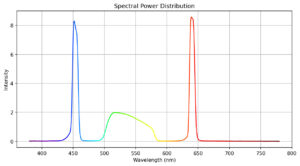
Screens of this type are gray and, compared to a white screen, they always introduce some degree of color deviation. This generally means you will need to adjust the projector settings to compensate for these shifts. Proper calibration remains the only truly reliable solution, but I will at least give you an overview of the changes observed here.Here is the spectral distribution of white generated by a laser projector on the NothingProjector screen:
I performed the same measurement using my neutral Teflon reference surface. Initially, I wanted to overlay both graphs, but the result was not very readable. I therefore created a graph showing only the differences:
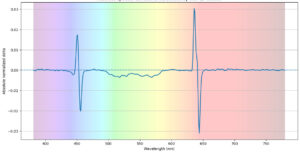
This graph illustrates the differences for each wavelength between the PTFE Teflon reference surface and the ALR screen. We can observe larger deviations after the violet range, at the beginning of cyan, and again at the beginning of the red range. The lower part of the curve indicates that a given color is more strongly absorbed by the screen, while positive values indicate that the color is reinforced.
You should not focus too much on isolated peaks or dips. It is more important to look at the overall behavior of the curve in order to understand the impact on the full color spectrum. For example, the dip visible in the center is not compensated elsewhere, and this kind of imbalance is exactly what influences the overall tint of the image.
ALR screens often tend to cool down the image, and this is also the case here.
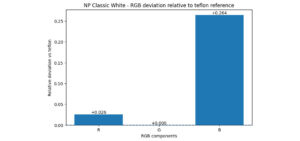
This graph illustrates color deviation in a much easier way to understand. I measured white on this screen and compared it to my neutral Teflon surface. We can clearly see that blue is strongly boosted, green remains almost neutral, and red is slightly enhanced. As a result, whites will appear cooler.
As with all screens of this type, the important question is how large this deviation is compared to another ALR screen.
Here is the result for the NothingProjector BlackSeries:
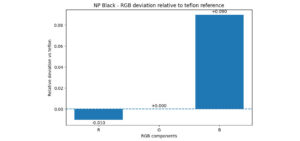
Blue enhancement is also visible here, but pay attention to the actual values associated with the graph. With the Classic, I measured +0.264 on blue, whereas the BlackSeries measured only +0.090.
What does that mean in practice? Here is a scale that I will now reuse in future tests:
| Relative RGB deviation | Score | Estimated visual impact | Interpretation |
|---|---|---|---|
| < 0.03 | 0 | Invisible | Difference normally imperceptible. |
| 0.03 to 0.07 | 1 | Very low | Very slight deviation, rarely noticeable. |
| 0.07 to 0.12 | 2 | Low but visible | Visible drift on white or neutral images. |
| 0.12 to 0.20 | 3 | Moderate | Clearly visible in direct comparisons. |
| 0.20 to 0.35 | 4 | Strong | Clearly visible deviation with likely impact on image rendering. |
| > 0.35 | 5 | Very strong | Significant deviation that is difficult to ignore. |
Viewing angle
Screens of this type often advertise a very wide viewing angle (for example 170°). In practice, this is usually not a problem for people sitting directly in front of the screen, but viewers seated on the sides often perceive a darker image.I measured luminance from different viewing angles and was surprised to see very little brightness loss, even at extreme angles. This is clearly a positive point for this screen, because I have tested other models with much narrower viewing angles that noticeably penalized people sitting at the edges of the couch.
Uniformity
I measured screen uniformity with an ultra short throw projector and then with a long throw projector. This screen is designed for UST projectors, but it can still work with a traditional projector if you are willing to accept some compromises.Ultra short throw projector
With this type of projector, luminance distribution across the screen resembles a sunrise: brightness is strongest at the bottom center and progressively decreases with distance. Taking this natural degradation into account, I obtained a uniformity score of 66%. This is the first screen I have tested using this methodology, so I do not yet have enough comparison points.
Long throw projector
The behavior here is completely different because the screen uses layered structures that capture light coming from above and redirect it toward the viewer. My long throw projector was positioned roughly at the center height of the screen. As a result, the central area paradoxically became the least bright because the light was reflected away in another direction.
The bottom area of the screen became the brightest because the layered structure was effectively redirecting the incoming light toward the front.
With this type of projector, you therefore lose more brightness than with a UST projector, but luminance also varies much more depending on projector placement. On large screen sizes, you will most likely end up with several zones of different brightness levels. Ideally, the projector should therefore be installed in a higher position to reduce this issue.
Speckle
I tested this screen with several projectors that have a relatively low tendency to generate speckle, and I did not notice any particular impact from this screen material. Unfortunately, I do not currently have a “worst-case scenario” projector available to verify whether the screen can effectively reduce speckle when used with a projector that produces a large amount of it.Operating noise
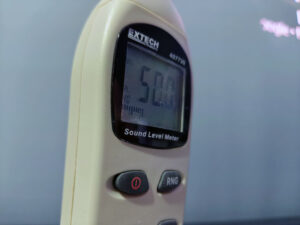
Motorized screens always produce some noise during deployment, and some models can be particularly loud. I measured around 50 dB close to the screen while it was deploying. That may sound high, but it is significantly lower than the 59 dB I measured on the other NothingProjector motorized screen I tested. The screen is therefore still audible, but not to the point of waking someone sleeping in the next room.
Chemical smell
Most screens of this type release an unpleasant chemical smell during the first few hours of use. This screen is no exception: the smell is clearly noticeable when first unpacked, but it fades relatively quickly. I did not need several days to get rid of it, unlike some other screens I have tested in the past.Comparison
I compared this NothingProjector Classics with two other screens tested under the exact same conditions because evaluating a screen in isolation does not really make much sense. A comparison provides much better context for understanding its strengths and weaknesses.I first tested a standard white screen with a gain of 0.96. This type of screen is not suitable for UST projectors, and the numbers make that very clear. I then compared the Classics to the other floor-rising NothingProjector screen using the BlackSeries material.
vs white screen
A traditional white screen reflects light uniformly in every direction. This means that light coming from below is largely reflected toward the ceiling instead of being redirected toward the viewer.
In a dark room, this is not necessarily a major issue unless you dislike having your walls and ceiling illuminated during bright scenes. In daylight conditions, however, this is definitely a combination to avoid because the image becomes so washed out that it quickly turns unpleasant to watch.
The numbers speak for themselves. I measured a luminance of 82 cd/m² for white on the NothingProjector Classics, compared to only 47 cd/m² on the white screen. This represents a 43% loss from the viewer’s position.
It may sound counterintuitive that a gray screen can produce a brighter image than a white screen, but this is exactly where the layered ALR structure becomes important. A large portion of the light that would normally be lost toward the ceiling is redirected back toward the viewer.
Brightness loss is therefore very significant on a white screen, but black levels are also much less controlled. Blacks quickly turn grayish. In practice, black luminance is almost twice as bright as on an ALR screen.
vs NothingProjector BlackSeries screen
The comparison with a white screen mainly serves to demonstrate the difference between two completely different technologies. The ALR screen clearly wins in this scenario. But what happens when comparing it to another ALR screen?
The NothingProjector BlackSeries has a theoretical gain of 0.6, and I measured an actual gain of 0.62. This results in a significantly darker screen than the Classics. However, this is not a flaw: the BlackSeries was specifically designed to prioritize contrast.
Daylight conditions
NothingProjector Classics:
* white gain: 0.74
* black gain: 0.56
* contrast gain: 150%
NothingProjector BlackSeries:
* white gain: 0.53
* black gain: 0.22
* contrast gain: 247%
Dark room
NothingProjector Classics:
* white gain: 0.8
* black gain: 0.66
* contrast gain: 21.9%
NothingProjector BlackSeries:
* white gain: 0.5
* black gain: 0.44
* contrast gain: 35%
The Classics therefore preserves more brightness, while the BlackSeries clearly focuses more aggressively on contrast and black level control.
Conclusion
NothingProjector is still a relatively young brand, but within only a few years it has managed to establish itself as a strong reference in the ALR screen market thanks to its excellent price-to-performance ratio. I already achieved very good results with the BlackSeries lineup, and now the Classics series is trying to carve out its own place.The Classic ALR screens are less expensive, so it would be easy to assume they are simply inferior to the BlackSeries. That is partially true, but it is important to understand where the actual differences lie.
From a mechanical standpoint, this new series is better than the previous one. The screen is significantly quieter, and the chemical smell is less pronounced. Looking specifically at the screen material itself, I observed that the Classic introduces a stronger color deviation than the BlackSeries, with a noticeable blue boost and a slight red enhancement. This is typical behavior for ALR screens, but the BlackSeries controls it more effectively.
The same observation applies to contrast. The Classics already provides a noticeable improvement in contrast (+21.9%), which is a good result. However, the BlackSeries performs even better with a contrast gain reaching 35%.
This review is probably quite dense to read, but my goal is to provide as much information as possible so that you can better understand the real impact this type of screen has on image quality and make an informed decision.
The conclusion itself is much simpler.
The NothingProjector Classic is an ALR screen with undeniable strengths. Its moderate gain allows for deeper blacks without sacrificing too much brightness. The contrast improvement is real, but you will have to accept a more noticeable blue shift. In most cases, this deviation can be corrected through projector settings or proper calibration.
Strengths
* 0.8 gain (not too high, not too low)
* 21.9% contrast improvement
* wide viewing angle
* quieter than the previous model
* good ambient light absorption
Weaknesses
* visible blue deviation
* very heavy (do not expect to move it easily from one room to another)



Commentaires (3)